Saturday, June 17, 2006
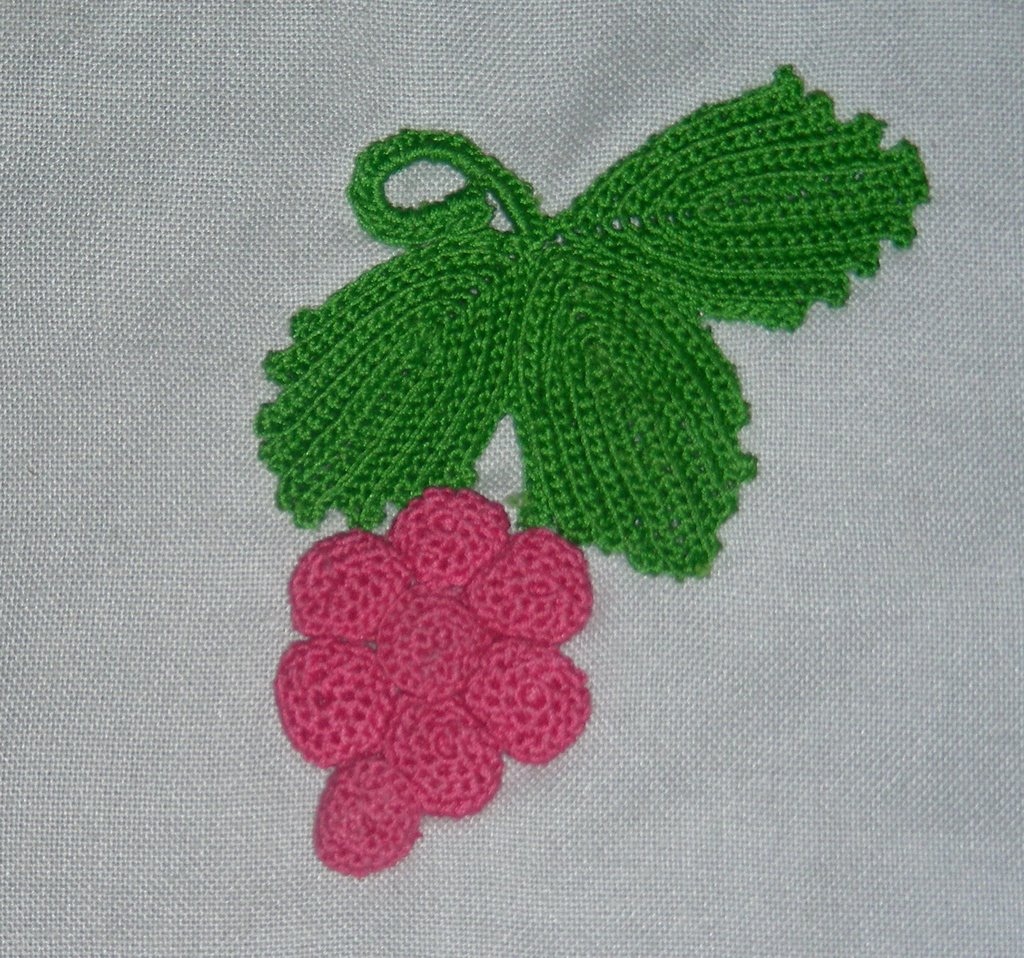
Grapes and Leaves in Irish Crochet
This is my version of the vintage grapes and leaves free pattern I found in a Crochet site. I stuffed a little batting instead of thread for the grapes. A pity I could not get the exact shades of thread for the grapes and leaves. Anyway I think this would make a wonderful applique.


Thursday, June 15, 2006
Drawn Thread Embroidery
This pattern is from TH.De. Dillmont's Encyclopedia of Needlework.
I worked this sampler in 1999. It was my first drawn thread embroidery attempt. Now I use it as a sampler to teach my students this technique.
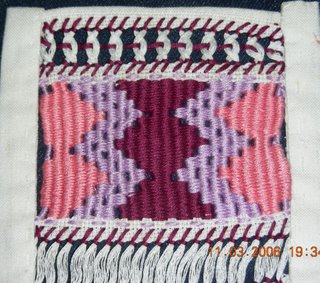
This is one of my unfinished projects. I cut the wrong thread accidentally and it has been lying around for at least five years now. Unfortunately, it cannot be salvaged. One of the downsides to choosing an elaborate project.
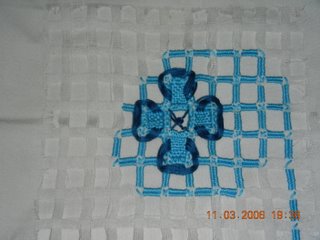
I worked this sampler in 1999. It was my first drawn thread embroidery attempt. Now I use it as a sampler to teach my students this technique.
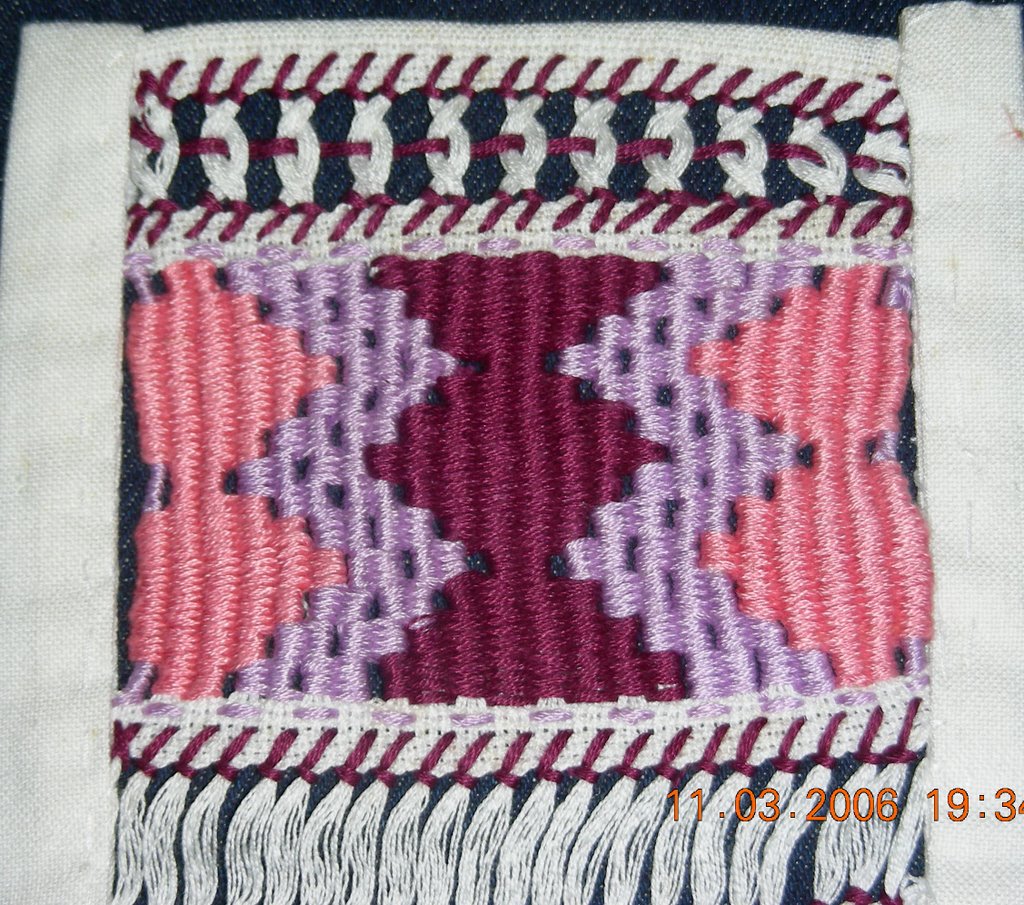
This is one of my unfinished projects. I cut the wrong thread accidentally and it has been lying around for at least five years now. Unfortunately, it cannot be salvaged. One of the downsides to choosing an elaborate project.


Irish Crochet
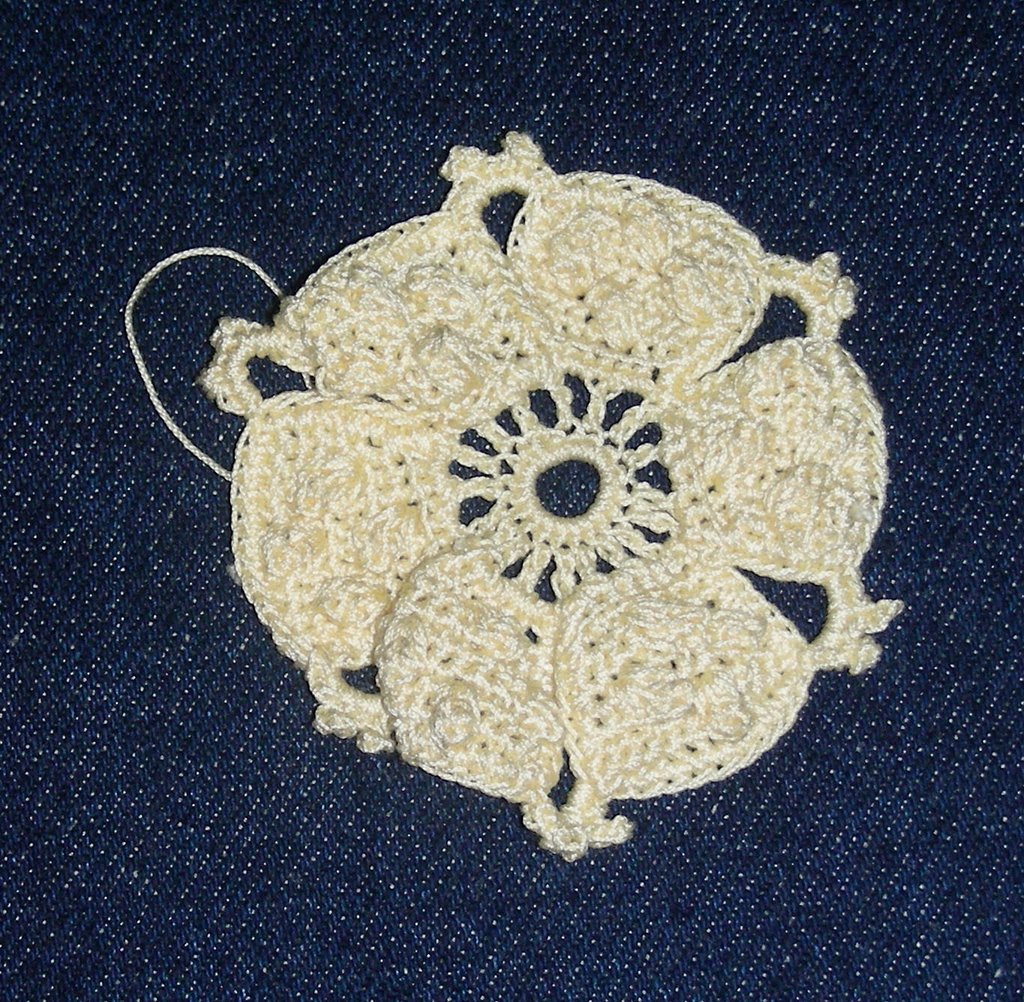
This is an Irish Crochet piece I am trying from the DMC Irish Crochet book. The book has been split into 4 pdf files and uploaded by The Antique Pattern Library. You can download them from the links below.
DMC Irish crochet I
DMC Irish Crochet II
DMC Irish Crochet III
DMC Irish Crochet IV
Will this look ok once I block it? Somehow I am not satisfied with it. Is my tension not right? I'll try redoing it.
Monday, June 12, 2006
Lagartera Embroidery
Lagartera is a style of Spanish 16th century embroidery that originated in a village of Lagartera, Spain The main stitches used are stroke stitch (Holbein stitch), the satin stitch blocks and the four-sided stitch. Considering the nature of the stitches, this embroidery is worked on even weave fabric.
Sometime in 2006, I came across a website with a lot of information about this style of embroidery. Unfortunately, it's no longer there and the there is dearth information regarding this. I save the pages mainly for the images. So, I do have something to work with.
I decided to use these stitch images and dream up my own combinations and this is what I came up with. I simply started at the center and added proceeded as the mood took me. I am yet to chart it. When I do, I'll add the link to it here.

Update: 25/3 2014 - Here's the chart.
Thursday, June 08, 2006
Huck Embroidery
My latest project is Huck embroidery. I have started embroidering a table cloth in this style. It might end up as a runner.
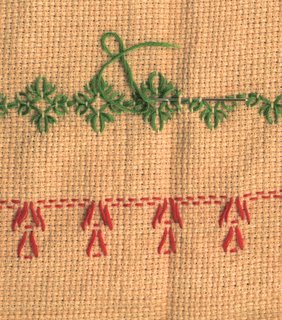
I have 7 uncles on my mother’s side. But for 2 the rest were craft enthusiasts. One of them still is. She does a lot of Huck embroidery. Her son-in-law is an engineer in the army and they get free army issue toweling cloth (I don’t know why this fabric is called so, maybe they were originally issued to be used as towels) on which this style of embroidery is done. Every time she visits her daughter in Delhi, she gets together with the neighbors to embroider. The funny thing is my aunt speaks only Tamil or Telugu and her embroidery friends speak only Hindi. God knows how they manage to communicate. But she comes back with a lot of lovely patterns copied from somebody’s grandmother’s shopping bag or somebody’s mother-in-law’s tablecloth embroidered some 20 – 50 years ago. And every time I visit her, I have something new to add to my collection.
Over the years I have accumulated quite a few patterns myself, some from my own grandmother, some from my mother’s imagination, some others from my school days, some from the collections of my students’ mothers or mothers – in – law. I found it mostly done on shopping bags.
While researching the subject recently, I found this blog
Swedish Huck Embroidery has posted some samples and the pictures are very clear.
Complete Guide to Needlework – A Reader’s Digest Publication has a chapter on this topic.

I have 7 uncles on my mother’s side. But for 2 the rest were craft enthusiasts. One of them still is. She does a lot of Huck embroidery. Her son-in-law is an engineer in the army and they get free army issue toweling cloth (I don’t know why this fabric is called so, maybe they were originally issued to be used as towels) on which this style of embroidery is done. Every time she visits her daughter in Delhi, she gets together with the neighbors to embroider. The funny thing is my aunt speaks only Tamil or Telugu and her embroidery friends speak only Hindi. God knows how they manage to communicate. But she comes back with a lot of lovely patterns copied from somebody’s grandmother’s shopping bag or somebody’s mother-in-law’s tablecloth embroidered some 20 – 50 years ago. And every time I visit her, I have something new to add to my collection.
Over the years I have accumulated quite a few patterns myself, some from my own grandmother, some from my mother’s imagination, some others from my school days, some from the collections of my students’ mothers or mothers – in – law. I found it mostly done on shopping bags.
While researching the subject recently, I found this blog
Swedish Huck Embroidery has posted some samples and the pictures are very clear.
Complete Guide to Needlework – A Reader’s Digest Publication has a chapter on this topic.
Subscribe to:
Posts (Atom)