Saturday, April 29, 2006

Brazilian embroidery

This is my attempt at Brazilian style Embroidery.
The first time I came across this style JDR Brazilian Elegance about six months back, I was stunned.
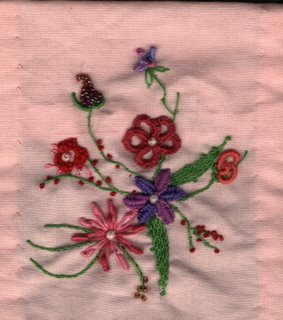


The double cast on stitch I used for the flower in 2 shades of purple and a bead in the center turned out quite well. And naturally, I am pleased.
The cast on stitch in red is a bit irregular and shabby.
The bullion flower looks better than I expected.

I love the flower worked in Bullion tipped lazy daisy stitch.
The drizzle stitch flower in variegated purple looks better in the picture than it actually looks. I think its unruly behaviour takes a bit of getting used to.

As for the red flower in detached buttonhole stitch, I need to practice the stitch some more.
The pistil stitch in pink is barely visible.
The leaves, I worked in stacked stem with a few French knots scattered along the edge.
The tiny bead flower I tried out after seeing a design in JDR Brazilian elegance.

In the JDR Brazilian Elegance's teaching kits, the focus is on how to use the different stitches unique to this style.
The cast on stitch, the double cast on stitch and the drizzle stitch are clearly explained in Sharon’s stitch dictionary.
The bullion tipped daizy stitch, I picked up from a tutorial by Sunshine in JDR Brazilian elegance. You can join Brazilian embroidery tutorial 101 to get free instruction in your mail.

Friday, April 28, 2006

Kasuti Sampler II


The motif above is called the Padma or the lotus. Next to the Gopur or the temple dome, this motif is the most popular. I have not removed the net I used as grid for counting.

Below is a picture of the wrong side of the fabric. You can see why Kasuti is called reversible. Except for the finished ends woven in, the pattern looks exactly the same on both sides of the fabric.


This now is a tough one. It is done in a style called Murugi kasuti (meaning twisted). Motifs typical to this style have a lot of zigzags. It is easy to get lost trying to work this motif.


With the sampler out of the way, I can concentrate on a step by step tutorial. I'll post pictures and instructions in my KASUTI TUTORIAL as I go along.

Thursday, April 27, 2006

Kasuti Sampler I

I have prepared a sampler with a few patterns ranging from basic to challenging.


The first 2 patterns are as can be seen are pretty simple.
The third and fourth require a bit more attention and concentration.

The peacock motif below is sightly more complicated.


The picture below is the peacock motif on the wrong side of the fabric.


Tuesday, April 25, 2006

Bit off more ...

Think I bit off more than I can chew. It is summer holidays for the kids. They are underfoot all they time. When they are'nt, I have to act as refree everytime they decide to take a boisterous tumble. I never can be sure whether the boys are having fun or they are in a fight. Guess what? They don't thank me for trying to find out.

I finally managed to get some links added to the side bar. Looks like learning how to publish a blog requires more patience than learning needlework does. When some job takes longer than I think it should, I go and click the mouse... and wham! I have to repeat the job all over again. I keep telling myself Patience... Patience... But where is it when I really need it?

In the last couple of days, I completed a tiny crochet basket from Beeton's Book of needlework . I'll have to wait for dad's visit for a photo with his digital camera. This is the first time I am working with wire, so I am not very satisfied with the finishing. Any clues for a fine finish anyone?
One advantage is it does not need starching.

I am working on the kasuti sampler for the tutorial. It should be ready in a couple of days. Then, I'll start the step-by-step instructions.

Wishing you all good health and cheer.

Thursday, April 20, 2006

The embroiderer's Garden

Just returned from teaching Kutchwork to a batch of 7 students. It was a 4 day course. 5 out of the 7 mastered the technique. They want me to extend the duration to atleast one more day to clear all their doubts. So, I'll be busy tomorrow also.
After that who knows, they may sign up for my other courses.

I bought a couple of books on my trip to Chennai last week.

The Embroiderer's garden by Thomasina Beck is one.
I bought it because after reading so many craft blogs I noticed that most avid embroiderers are also avid gardeners. The title naturally made me curious and after browsing through it, I simply had to have the book. As the title implies, there are all sorts of wonderful gardens done in applique, counted thread, blackwork, brazilian stlye. There are no instructions. Plenty of ideas for compositions and some very striking examples but no instructions. Nevertheless it is a good book.

The second book is The Anchor Book of hardanger Embroidery. It contains dom 40 stitches and motifs.

Monday, April 17, 2006

Cathedral window Patchwork


This is my first attempt. It is clumsy. Any suggestions for turning out perfect cathedral windows are most welcome.

Kasuti Tutorial

I am back from my stay with my parents. I am working towards starting a step by step tutorial on Kasuti. I'll start posting lessons tomorrow in a separate Kasuti Tutorial blog listed in my profile page.


Meanwhile, here is another example of kasuti called Negi Kasuti (meaning woven embroidery). I have worked this on aida fabric. If anyone is interested in this design, make a request by email and I'll send you the chart. Click on picture to enlarge.

Sunday, April 09, 2006

NET USED FOR KASUTI


This is the net we use as grid. As you can see from the picture, there are two threads forming the horizontal line of the grid while there is only one forming the vertical line. Click on the picture to see the large view.

We are going away to my parents place for a week. I'll start posting again after the 17th April.

Saturday, April 08, 2006

More about Kasuti

More information about Kasuti

This beautiful style of embroidery dates back to the 7th Century A.D. It originated in the old provinces of present day North Karnataka. It spread down south in the course of time especially during the reign of the mighty Chalukyas, the Hoyasalas, the Rashtrakutas, the Pallavas and the Vijayanagar empires.

In tribal villages, women presented brides with a typical black saree with red border which they called Kali Chandrakala on which extensive kasuti was done. The credit for keeping alive this exacting art form goes to Ms.Ahilya Kirloskar and Ms. Indra Joshi. They introduced this art form to "Needle and Thread" - the only Needlework magazine in India. This Magazine is published by Coats India.

In Kasuti, all motifs are geometrical and it was originally executed by actually counting the threads of the fabric. Can you imagine how difficult that must have been? Yet these women turned out such work. Inspiration for the motifs were mostly drawn from every day objects like temple towers, tulsi plant (basil plant which we Indians consider very sacred – probably due to its medicinal qualities), peacocks, flowers, deer etc.

Another important aspect of this art form is that the motifs no matter how elaborate always ends where it began.

The only stitch used in sampler in the previous post is the Holbein stitch. The motif is quite simple and there is a small mistake.

Friday, April 07, 2006

Kasuti

"Kasuti" is a technique of embroidery Unique to the state of Karnataka - famous for its sandalwood forests and its beautiful garden city, Bangalore. "Kasuti" literally means embroidery in the local language.

What I find interesting about this technique is its similarity to Spanish Blackwork.
Of course the motifs and depictions are different, but the technique is the same. Kasuti is reversible. Though I already knew about blackwork, (I have even worked a couple of samplers) I discovered only recently that it was reversible.

Started out using Aida fabric for the embroidery. Slowly graduated to using a net as grid laid over the fabric to be embroidered. Here is a small sample of one of my first pieces using net as grid. The net is removed once the embroidery is complete.


Sunday, April 02, 2006

Objectionable Content

I don't know what happened. But when I try to access the internet,I keep getting pop-ups of objectionable content every now and then. I'll have to call in the experts. So I won't be posting for a while.