Translate

Sunday, March 31, 2013

Free Instructions for Split Ring Beaded Tatted Edging

I assume you are familiar with split ring tatting.

Since it's split ring tatting, we obviously need to wind two tatting shuttles. Load the thread of one shuttle with the required number of beads if you want beads only on one side of the edging, and both shuttles if you want the beads on both edges.


Step 1: With Shuttle 1, ring of 5 ds, 5 p sep by 5 ds,  5 ds close ring.
Step 2: With shuttle 1, ring of 5 ds, join to the last picot of the 1st ring, 5 ds, 3 p sep by 1 ds, 5 ds, p, 5 ds close ring. If you want beads in your picots, place the required number of beads in your ring.
Step 3: With shuttle 2, push 1 bead into the ring and 5 ds, join to the 1 st picot of the 1st ring, 5 ds, p,ds, beaded picot, ds, p, 5ds, p, 5ds close ring.
Step 4: Split ring of 5 ds, join to the last p of the 3rd ring, 5 ds, p, 5ds/ 5ds, join to the 3rd p of the 2nd ring, 5 ds, p, 5ds, close ring.
Step 5: Split ring of 5ds, 2 p sep by 5ds, 5ds/  5ds, 2 p sep by 5ds, 5ds, close ring.
Step 6 to end: Rep from step 2

Wednesday, March 27, 2013

Monograms in Filet Crochet and Tatting

This book contains charts and instructions for working letters and monograms in Filet Crochet. Housed in the Antique Pattern Library, this is one of the numerous crochet books, for free download, the library and its has put up over the past several years.

Here are some pictures from the book. There are about 17 pages in total.

These pages give a general idea of how to chart letters both for filet and for cross stitch. There are a few charts for tiny birds and animals that you can combine with the letters for a more customized look.


I like the C and the E in the chart above.  There are general working instructions and an abbreviations and definitions chart.


Maybe I am wrong, but I think this is the first book I've come across that has cross meshes for the letters of the Alphabet. 


Some monograms in tatting - cursive capital letters Will look beautiful when combined with embroidered flowers with a lot of beads add either to the tatting or the embroidery. Must try.

A book definitely worth downloading.

Wednesday, March 20, 2013

Filet Crochet Design Book for Free Download

For more Filet Crochet monogram designs, pop over to my post on  Assissi Embroidery and download load the book from the link there.

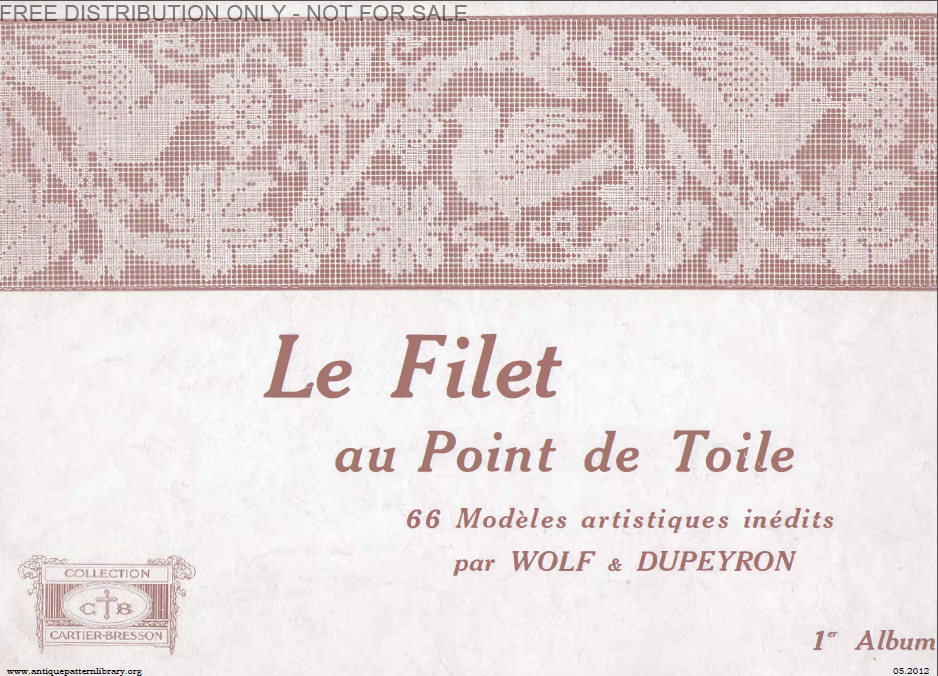
This post is about a book on Netting designs (I wonder if anyone does netting anymore), that can be adapted for Filet crochet and Assissi. Take a look at some of the designs for yourself. My favourite is the one on the cover. Here it is. Click on the pictures to enlarge.


 Very elaborate, with plenty of details. Goes without saying, that the design will eat up a lot of yarn, and a huge chunk of time and money. But it will definitely be worth the effort. I've learnt over the years the hard way, not to scrimp on the quality of yarn, when working on elaborate projects. So no more buying supposedly good quality yarns, sold at very cheap prices.

This book has about 26 pages and over 60 designs. If you want it, you can download it from here.

Free Instructions for Filet Crochet Curtain Ties

This is a very simple yet useful free filet crochet project. 


Here's how I made it:

Foundation chains = multiple of 8 + 6 + 3 turning chains  (multiples of 8 + 9)

8 x 12 = 96 + 9 = 105 chains.

Row 1:  1 dc into the 5th chain from hook. 1 dc into each of the next 100 chains, 3 chains turn.
Row 2:  1 chain,  skip 1 dc, *1 dc into each of next 2 dc, 2 ch, skip 2 dc; rep from * until only 4 dc are left. 1 dc into each of next 2 dc, 1 ch, skip 1 dc, 1 dc into last dc; 3 chains turn.
Row 3: 1 dc into each dc to end.

Here's the chart:


Insert a cord, braid or ribbon in the space between stitches in row 2.  I made my cord.  I'll post the method in my next post.

Sunday, March 17, 2013

Monograms for Embroidery, Cross-Stitch and Filet Crochet

Here are some more monograms from "The Antique Pattern Library". This book contains some really beautiful letters that can be used for both cross-stitch and Filet. The last few pages contain  Lets and borders for embroidery or fabric painting.


You can download this book from here.

Friday, March 15, 2013

Monograms for Painting and Embroidery - The Letter D

I been collecting monograms since several years. You find interesting monograms in old books (no, I don't mean design books). The first letter of a chapter usually starts with a monogram. They don't that anymore. Here's a monogram, I found on the cover of a diary.


If you want all the intricate background details, click on the image to enlarge.  I've seen this kind of decorative work in a 1913 Cassell and Company, Ltd. publication Decorative Designs for All Purposes edited by Paul N. Hasluck. The book has an image of a marble column of Ancient Rome similar to the style featured above. While this background image is would make wonderful marble and wood carvings, it would work just as well for both embroidery, fabric painting or pencil sketching.

Thursday, March 14, 2013

Tuesday, March 12, 2013

Flower Motif for Shadow Work


Daisy Chains Tutorial

I wanted to complete the beaded strap for my cell phone pouch. So I sat at it and completed it today. As I was working, it occurred to me that maybe I could do a simple tutorial on this technique, and I took pictures of each of the steps. Here they are. The pictures are self-explanatory.


Isn't this a terrible strain for your eyes? Not if you use a needle. Then you can do this blindly. Well, almost. Another trick is to use a threader to load the beads.

If you can find the needles, wire and beads that work well together, you can have fun making all kinds of exoctic things with this beautiful beading pattern. 

With the long summer vacations ahead, kids can drive you crazy. Keep them engaged with this project!!!

Monday, March 11, 2013

Sunday, March 10, 2013

Flowers

Lovely motif for Brazilian embroidery, bead work, ribbon embroidery, fabric painting, free style embroidery etc.


Saturday, March 09, 2013

Dog Motif


Step by Step Working of Assissi Embroidery

Origin: Assissi Embroidery is a style of embroidery that evolved in the 13th and 14th century in the Italian town - Assisi. In 1902, this style was saved from obsolescence and popularized by Saint Francis of Assisi. Inspiration for new designs was drawn from the relief stonework and the exquisite carvings in the chests and other wood work found in the church.  The churches of the town have done their bit to carefully preserve some of the earlier work. It's thanks to them and to those who turned Assissi embroidery into the cottage industry of the town, that we know what we do today, about this lovely embroidery. The style has some distinct features that make it easily identifiable.

Identifying Assissi Embroidery: The design itself is void while the outlines and background are embroidered in Holbein and cross stitches respectively. Sometimes in places like near the head of birds etc, a slanting stitch is used. The subjects like demons and animals usually look mean  and the earlier designs were usually very crude.  Floral motifs too are used. But they don't seem to be as popular as the demons, birds and animals. There is almost always a border worked completely in Holbein stitch with maybe a cross-stitch here and there.

Fabric: We should remember that a couple of centuries ago, fabrics expect for perhaps silk or satin, were more loosely woven or coarse, so the outlines were drawn directly on fabric and then embroidered. These days we have to use Aida fabric or end up with eye problems.

Colours Used: Faded sky blue and rust brown tones were the commonly used shades in the original work. Later on, a dark blue, bright red and a bronze yellow etc were introduces to make the work looked brighter. The outlines of the designs are done in a deeper contrasting colour such as black, dark blue or green or even a vivid red.

The Design Elements
There are 4 elements - the outlines, the voids, the cross-stitch and the border framing the designs. They are worked in 3 steps.

Step 1: Holbein stitch done in 2 rows- the first laying the outline  and the second completing the outline in a return journey.

The DMC Assissi Embroideries book recommends that you work all complementary lines that depart from the main design (like the detailing of the swans feathers in the image below), while working the first row itself.

Here's an interesting tidbit. Spanish Blackwork and Kasuti of Karnataka also use the Holbein stitch. The stitches in all three styles are worked such that, but for the knots, it is impossible to distinguish between the right and the wrong side of work. Only, in the case of Assissi, once you fill in the cross stitches, you'll know.

Step 2: Filling the background with cross- stitch.


Step 3: Working the borders in Holbein stitch. 

Resources:

1. Reader’s Digest – Complete Guide to Needlework - I own a copy of this book. An excellent buy.

2. Mary Thomas's Embroidery Book - again an excellent buy

Instructions for Tatted Bookmark from Wedding Card


I find it difficult to throw away exorbitantly priced wedding invitations.


I have always wondered why some people think it is important to spend so much on such cards knowing that it's going to serve no purpose once the wedding is over

I have saved up quite a few such cards. Now, I am trying to find ways to use them up. I have come up with the idea of using them as embellished books marks (they are more exciting and definitely more personalized than simply cutting the cards into book mark sized strips). Besides, I have a lot of friends who will treasure such personalized book marks.

Here is one such book mark embellished with split ring tatting. It does make a cute book mark.
Here are the instructions:

Step 1: Ring of 5 ds, 3 p sep by 5 ds, 5 ds, close ring.

Step 2: Ring of 5 ds, join to the 3rd p of prev ring, 5 ds, 2 p sep by 5 ds, 5ds, close ring.

Step 3: Repeat step 2 more times.

Step 4 (Split ring): Ring of 5 ds, join to the 1st p of the 1st ring, 5 ds/ 5 ds, join to the 3rd p of the last ring, 5 ds close ring.

Step 5 (Split Ring): 5 ds, p 5 ds/ 5ds, p, 5ds, close ring.

Work 3 more split rings.

Friday, March 08, 2013

Fish Motif


Applications: Embroidery, fabric painting  or even applique on baby clothes.

Design Ideas: Use it on pockets, the yoke of rompers, back of shirts, pillow shams, walls etc.


Saturday, March 02, 2013

Beaded Strap

I got the idea from a Russian beaded jewelry book. There are very clear pictorial instructions. I've adapted the design to suit my requirement.

I thought I'll make 2 strands clasped occasionally with a larger bead. Have to work it out. I've tried out several options. Haven't come up with a satisfactory idea as yet. I've decided that the ideal length for the strap is 35". That's it for now.  Here's a close-up of the design.


This is actually a variation of a design I posted a couple of years back.

Friday, March 01, 2013

Final Design in the Free Bird Designs Series

Bird Series - Design 4

This is the last of the 4 designs in the Bird Series.

Application: Embroidery or fabric painting.
Design ideas:  You can use beads or french knots for the flowers. But if you are using it on baby clothes, avoid beads. There are two reasons for this. The beads will poke the baby's tender skin when it is on its tummy. The other reason is, the baby might pull it off and swallow it.


Enjoy these patterns and while you're at it don't forget to let me know what you did with them.